
Showing posts with label interview. Show all posts
Showing posts with label interview. Show all posts
Friday, September 9, 2011


Thursday, March 10, 2011
milton glaser: an interview
for work
last year
i was
blessed
with the
chance to
interview the
godfather of
graphic design
Milton Glaser.

I understand you grew up in a progressive part of the Bronx at the beginning of The Great Depression. How did this environment impact you philosophically and can you speak to how your life experience there led to becoming an artist at such a young age?
I have no idea why anyone wishes to become an artist. I do know that at the age of 5, I made a decision to spend my life making things and I have never deviated from that objective. The motivation to see the world from the left or right philosophically is buried in the mysteries of the mind, although I find a liberal bias is more prevalent in artists. I associate liberalism with an open mind, which includes the possibility of one's being wrong. A characteristic of the right is 'certainty', which certainly inhibits the imagination.
One more nice fact to recall: 95% of the kids that grew up in my neighborhood went on to college.
After finishing your high school education, you were denied entrance to Pratt. Do you think, in retrospect, that not getting in was perhaps a blessing in disguise?
Perhaps. Altered plans frequently turn out to be blessings. And remember, not only did I fail the Pratt entrance examination, I also failed the Pratt nightschool examination. I'm probably the only student to ever fail the nightschool examination. After my double-flunking, and since I hadn't applied for any other college, I went to work at a package design studio. A year later, I went on to Cooper Union. The little bit of professional experience I got from the design studio gave me slight edge over the other students.
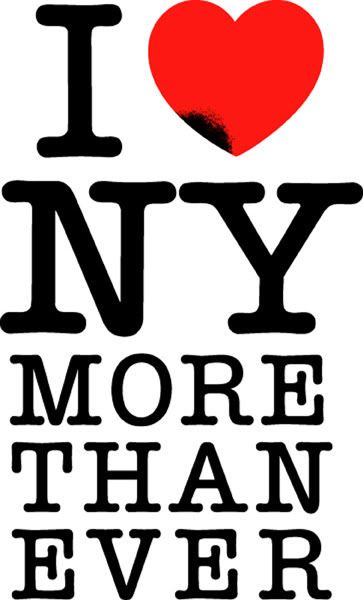
You were one of the founding members of Pushpin Studio. How did Pushpin originally come about?
Pushpin came about because Ed Sorel, Seymour Chwast, and Reynolds Ruffins and I were fellow students at Cooper Union. While there, we started a small company called Design Plus, whose sole activity was printing cork place mats. After finishing our schooling, we went our separate ways until we reunited in 1954 to start Pushpin Studios. I suspect it was the pleasure we found working together that made us want to recreate that experience as professionals. (Although by any standard, we were far from professional.)
When you started publishing the Pushpin Almanac was it a labor of love or a really clever way of attracting new clients? or a bit of both?
I was in Europe on a Fulbright when Reynolds, Ed and Seymour created the Almanac It was their way of communicating with other designers (and possible clients). The Almanac broke away from prevalent modernist vocabulary,and integrated design, typography and illustration in a fresh way. When I got back from Europe in 1954, I joined the others and, based on the success of the almanac, we decided to open Pushpin Studios.
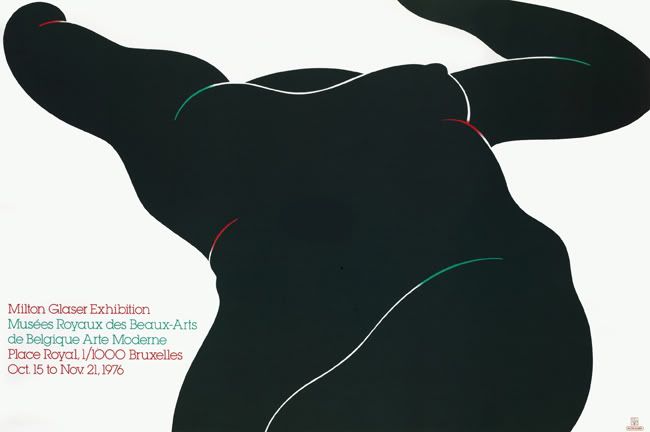
When teaching, how do you connect ethics to applied arts for your students?
For me, there's no way of teaching design without engaging the relationship between design and ethics. This means that in creating a work that communicates to a public, the artist must include the question, "What are the consequences?" If this question is not considered, design becomes simply a way to create an ideology or make money.
What major changes have you seen, through time, in applied arts in regards to ethics and to what do you attribute this?
It's difficult to discern what real changes have occurred. Certainly there is a significant amount of lip-service given to design and its social effect. As a result it has become more trendy to be concerned about these issues. I say this not disparagingly because in our culture, when things become trendy, they frequently produce change.
What advice would you give to young graphic designers with respect to maintaining artistic integrity within the commercial spectrum?
What do we mean by artistic integrity? Do we mean persisting in our ideas even though they may be demonstrably wrong-headed? Do we mean that despite a client's concerns, we act as though the only solution is the one we have decided on? Is there a difference between artistic integrity and egocentricity? On the other hand, if the question becomes, "Is harm being done?" the issue becomes somewhat simpler.
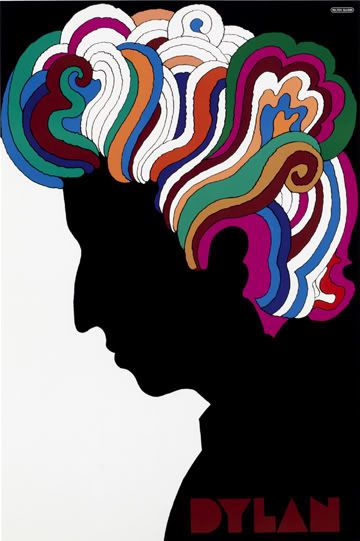
For a period of time the computer was king in graphic design. However, there seems to be a return to pen and paper. What do you feel has brought about this shift?
I love the computer. But I'm convinced only people over 40 should be allowed to use it. The problem with the computer is that it is too powerful a tool for inexperienced people to use. That's because, if you have not already developed your sense of form through the arduous experience in making things, the computer will impose its will on you. It, and not you, will determine your sense of size, scale, color and value. Soon, everyone noticed that every job produced on the computer tended to look alike. And that was probably because inadvertently, every designer began thinking in terms of what the computer was most comfortable creating. This is as insidious as it is inevitable. The shift back to pen and paper came about because people realized that any designer's sense of form is won through frequent repetition of the relationship of the eye to the brain to the hand. There is no better way of developing aptitude.
Along with Picasso and Morandi, you have said that William Morris has been an influence on your work. Who, or what, has been the biggest influence on your aesthetic?
I remain fascinated by the relationship between Morandi and Picasso. Picasso was a man who wanted everything, every style, every medium, all the money, all the women, all the fame. His work is full of virtuosity, interesting narratives, enormous scale, and overwhelming success as seen by the public.
Morandi was a man who wanted nothing. He didn't travel, he lived alone with his three sisters, his paintings were small and without narrative, his use of color was subdued and underdramatized. The work seemed without virtuosity or impressive technique.
So here's the question: In a contest between these two extraordinary polarities, who wins? In my perception, it's a toss up. The result of this perception is my realization that the things we believe are important in works of art may be illusionary and, when it comes right down to it, 'tain't whatcha do, it's the way thatcha do it.
Over the years it seems, many of the decorative, descriptive elements of your work have fallen away and yet it remains very narrative. Was this the result of a process or natural progression?
Isn't natural progression a process? Yes to both.
Do you still feel nervous when you submit your work to a client?
I don't think so.
After all this time, what keeps you inspired and motivated?
First, the idea that I might learn something new that day. Second, working with the delightful people in my studio. Third, what else could I possibly be doing?
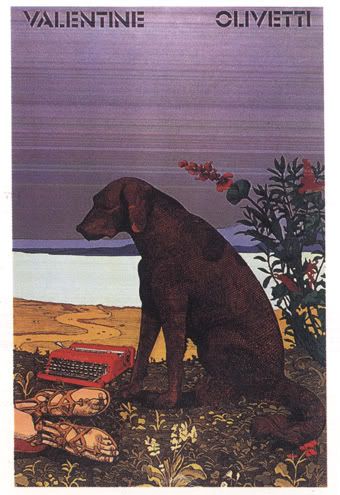
photo: Molly Watman
all images used by permission
from Milton Glaser Inc.
last year
i was
blessed
with the
chance to
interview the
godfather of
graphic design
Milton Glaser.

I understand you grew up in a progressive part of the Bronx at the beginning of The Great Depression. How did this environment impact you philosophically and can you speak to how your life experience there led to becoming an artist at such a young age?
I have no idea why anyone wishes to become an artist. I do know that at the age of 5, I made a decision to spend my life making things and I have never deviated from that objective. The motivation to see the world from the left or right philosophically is buried in the mysteries of the mind, although I find a liberal bias is more prevalent in artists. I associate liberalism with an open mind, which includes the possibility of one's being wrong. A characteristic of the right is 'certainty', which certainly inhibits the imagination.
One more nice fact to recall: 95% of the kids that grew up in my neighborhood went on to college.
After finishing your high school education, you were denied entrance to Pratt. Do you think, in retrospect, that not getting in was perhaps a blessing in disguise?
Perhaps. Altered plans frequently turn out to be blessings. And remember, not only did I fail the Pratt entrance examination, I also failed the Pratt nightschool examination. I'm probably the only student to ever fail the nightschool examination. After my double-flunking, and since I hadn't applied for any other college, I went to work at a package design studio. A year later, I went on to Cooper Union. The little bit of professional experience I got from the design studio gave me slight edge over the other students.

You were one of the founding members of Pushpin Studio. How did Pushpin originally come about?
Pushpin came about because Ed Sorel, Seymour Chwast, and Reynolds Ruffins and I were fellow students at Cooper Union. While there, we started a small company called Design Plus, whose sole activity was printing cork place mats. After finishing our schooling, we went our separate ways until we reunited in 1954 to start Pushpin Studios. I suspect it was the pleasure we found working together that made us want to recreate that experience as professionals. (Although by any standard, we were far from professional.)
When you started publishing the Pushpin Almanac was it a labor of love or a really clever way of attracting new clients? or a bit of both?
I was in Europe on a Fulbright when Reynolds, Ed and Seymour created the Almanac It was their way of communicating with other designers (and possible clients). The Almanac broke away from prevalent modernist vocabulary,and integrated design, typography and illustration in a fresh way. When I got back from Europe in 1954, I joined the others and, based on the success of the almanac, we decided to open Pushpin Studios.

When teaching, how do you connect ethics to applied arts for your students?
For me, there's no way of teaching design without engaging the relationship between design and ethics. This means that in creating a work that communicates to a public, the artist must include the question, "What are the consequences?" If this question is not considered, design becomes simply a way to create an ideology or make money.
What major changes have you seen, through time, in applied arts in regards to ethics and to what do you attribute this?
It's difficult to discern what real changes have occurred. Certainly there is a significant amount of lip-service given to design and its social effect. As a result it has become more trendy to be concerned about these issues. I say this not disparagingly because in our culture, when things become trendy, they frequently produce change.
What advice would you give to young graphic designers with respect to maintaining artistic integrity within the commercial spectrum?
What do we mean by artistic integrity? Do we mean persisting in our ideas even though they may be demonstrably wrong-headed? Do we mean that despite a client's concerns, we act as though the only solution is the one we have decided on? Is there a difference between artistic integrity and egocentricity? On the other hand, if the question becomes, "Is harm being done?" the issue becomes somewhat simpler.

For a period of time the computer was king in graphic design. However, there seems to be a return to pen and paper. What do you feel has brought about this shift?
I love the computer. But I'm convinced only people over 40 should be allowed to use it. The problem with the computer is that it is too powerful a tool for inexperienced people to use. That's because, if you have not already developed your sense of form through the arduous experience in making things, the computer will impose its will on you. It, and not you, will determine your sense of size, scale, color and value. Soon, everyone noticed that every job produced on the computer tended to look alike. And that was probably because inadvertently, every designer began thinking in terms of what the computer was most comfortable creating. This is as insidious as it is inevitable. The shift back to pen and paper came about because people realized that any designer's sense of form is won through frequent repetition of the relationship of the eye to the brain to the hand. There is no better way of developing aptitude.
Along with Picasso and Morandi, you have said that William Morris has been an influence on your work. Who, or what, has been the biggest influence on your aesthetic?
I remain fascinated by the relationship between Morandi and Picasso. Picasso was a man who wanted everything, every style, every medium, all the money, all the women, all the fame. His work is full of virtuosity, interesting narratives, enormous scale, and overwhelming success as seen by the public.
Morandi was a man who wanted nothing. He didn't travel, he lived alone with his three sisters, his paintings were small and without narrative, his use of color was subdued and underdramatized. The work seemed without virtuosity or impressive technique.
So here's the question: In a contest between these two extraordinary polarities, who wins? In my perception, it's a toss up. The result of this perception is my realization that the things we believe are important in works of art may be illusionary and, when it comes right down to it, 'tain't whatcha do, it's the way thatcha do it.
Over the years it seems, many of the decorative, descriptive elements of your work have fallen away and yet it remains very narrative. Was this the result of a process or natural progression?
Isn't natural progression a process? Yes to both.
Do you still feel nervous when you submit your work to a client?
I don't think so.
After all this time, what keeps you inspired and motivated?
First, the idea that I might learn something new that day. Second, working with the delightful people in my studio. Third, what else could I possibly be doing?

photo: Molly Watman
all images used by permission
from Milton Glaser Inc.
Thursday, March 3, 2011
interviewing: frohawk two feathers
here is
a little
interview
i did
with
frohawk two feathers
for our fall 2010
catalog
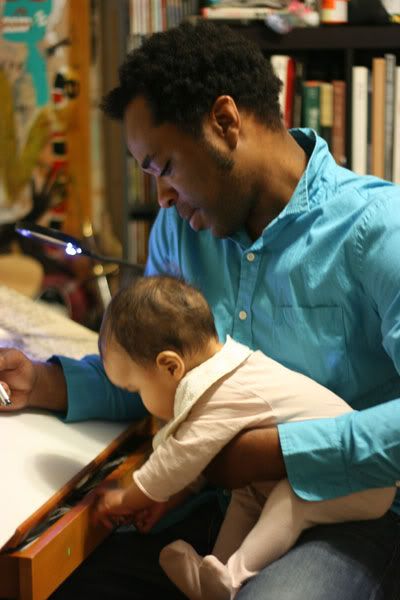
I know most people probably don’t know that originally you studied to be a photographer, what was the path that led you to painting?
I started to realize how much my ideal job as a portrait photographer would cost (and suck) so I decided to take the path less traveled.
Over the years your combination of portrait photography and painting has evolved into an extremely involved narrative. Can you explain to us the premise behind the story and where we are presently?
Great question. Much like my decision to move from photography to painting, the body of work that I’m creating now started with woolly mammoths and is currently in 18th century Europe. I started my story with a story about a woolly mammoth from outer space and that turned into a twisted tale of a young Inuit boy and an adolescent (female) harp seal. Then that turned into a eco-conscious tale about the same Inuit boy in the Age of Exploration, fighting against human empires, penguin empires and aliens to preserve his land, and culture. And later on as a lover of history and anthropology, I decided to rewrite the 17th to 19th centuries. Currently we are in the 18th century during the 50 Years War or The Greater Baltic Conflict.
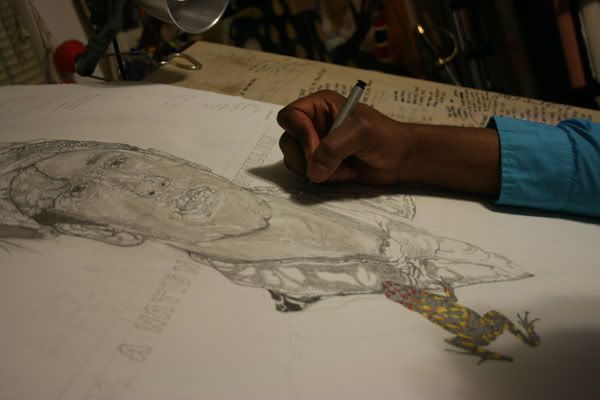
How do you choose your subject matter?
I choose my subject matter by the things that I like and current events. For example, right now I’m really into crocodiles, the Maghreb and ancient Egypt, so I synchronized all three into an elite fighting force called the ‘Company Crocodile’ that wear North African style fezzes and ride (only Barb) horses and dromedaries, tattoo their faces, and worship Sobek, the Egyptian crocodile god. And I really like celebrity gossip magazines so anything can happen.
You are also involved in a few musical side projects. One of your many aliases is the rapper known as Hi Fidel. When did you start rapping and how? When was Kent Cyclone born and where in the world did he come from?
I started rapping seriously when I was 15 years old (33 now so I’ve been in the game for a minute bitches) I’ve put out two records on F5 Records under (yet another alias) Hi-Fidel with DJ Crucial and I’m currently working on the follow up album to the Friday Night project with my buddy Serengeti and The Breakfast Kings, entitled Saturday Night. I’m also recording a record for my next opening entitled ‘Crocodile Company’ Kent, on the other hand is an entirely different beast. I created Kent Cyclone with my friend David Lohman a.k.a Blowdog in the late 90’s at Southern Illinois University. We wanted to enter the annual Battle Of The Bands and be all Dada like. I got booed but in the booing (expected) I discovered that if you provoke people and do it with a modicum of charm, they will at least listen to what you’re saying before they tell you to fuck off. As of today, my partner, Peggy Sue-Nami and I are recording a new album about relationships. It should be quite funny and entertaining. We hope.
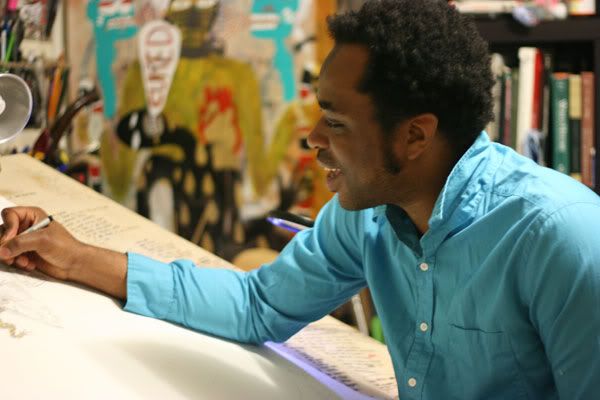
Congratulations on recently becoming a father. Has it affected your work in any way?
Thank you. Being a dad is great. And I can honestly say that the biggest influence this has had on me is, now I can teach my daughter how to avoid my steps and become a scientist, engineer, or something that pays off right away.
What has your experience been like working with 2K By Gingham?
Working with 2k was a dream a few years back and now it is a reality. So I will say that it is quite pleasant and I feel good to be surrounded by some of the most brilliant and creative people on the planet.
Anything new you’ve been collecting?
Due to diaper costs I unfortunately haven’t been purchasing much art but I do have my eye on a few people. And here they are, Katsuo Design, Noah Davis, Augustine Kofie, Henry Taylor, Frau Grau and Jeana Sohn. I want!
What is your dream project/ collaborator?
The big dreamers with the bright ideas and a tireless work ethic.
Do you have a favorite project that you’ve worked on?
The Company Crocodile. My latest work that involves a group of marooned slaves that fight for the Frenglish Empire to be able to own land and be self-governing, self sufficient. That’s where I want to be.
How long have you lived in Los Angeles and what are the best things about being here?
LA is still growing on me after a decade of residence but I don’t care where I am as long as I can be close to a large body of water. The thing I love most is transience.
a little
interview
i did
with
frohawk two feathers
for our fall 2010
catalog

I know most people probably don’t know that originally you studied to be a photographer, what was the path that led you to painting?
I started to realize how much my ideal job as a portrait photographer would cost (and suck) so I decided to take the path less traveled.
Over the years your combination of portrait photography and painting has evolved into an extremely involved narrative. Can you explain to us the premise behind the story and where we are presently?
Great question. Much like my decision to move from photography to painting, the body of work that I’m creating now started with woolly mammoths and is currently in 18th century Europe. I started my story with a story about a woolly mammoth from outer space and that turned into a twisted tale of a young Inuit boy and an adolescent (female) harp seal. Then that turned into a eco-conscious tale about the same Inuit boy in the Age of Exploration, fighting against human empires, penguin empires and aliens to preserve his land, and culture. And later on as a lover of history and anthropology, I decided to rewrite the 17th to 19th centuries. Currently we are in the 18th century during the 50 Years War or The Greater Baltic Conflict.

How do you choose your subject matter?
I choose my subject matter by the things that I like and current events. For example, right now I’m really into crocodiles, the Maghreb and ancient Egypt, so I synchronized all three into an elite fighting force called the ‘Company Crocodile’ that wear North African style fezzes and ride (only Barb) horses and dromedaries, tattoo their faces, and worship Sobek, the Egyptian crocodile god. And I really like celebrity gossip magazines so anything can happen.
You are also involved in a few musical side projects. One of your many aliases is the rapper known as Hi Fidel. When did you start rapping and how? When was Kent Cyclone born and where in the world did he come from?
I started rapping seriously when I was 15 years old (33 now so I’ve been in the game for a minute bitches) I’ve put out two records on F5 Records under (yet another alias) Hi-Fidel with DJ Crucial and I’m currently working on the follow up album to the Friday Night project with my buddy Serengeti and The Breakfast Kings, entitled Saturday Night. I’m also recording a record for my next opening entitled ‘Crocodile Company’ Kent, on the other hand is an entirely different beast. I created Kent Cyclone with my friend David Lohman a.k.a Blowdog in the late 90’s at Southern Illinois University. We wanted to enter the annual Battle Of The Bands and be all Dada like. I got booed but in the booing (expected) I discovered that if you provoke people and do it with a modicum of charm, they will at least listen to what you’re saying before they tell you to fuck off. As of today, my partner, Peggy Sue-Nami and I are recording a new album about relationships. It should be quite funny and entertaining. We hope.

Congratulations on recently becoming a father. Has it affected your work in any way?
Thank you. Being a dad is great. And I can honestly say that the biggest influence this has had on me is, now I can teach my daughter how to avoid my steps and become a scientist, engineer, or something that pays off right away.
What has your experience been like working with 2K By Gingham?
Working with 2k was a dream a few years back and now it is a reality. So I will say that it is quite pleasant and I feel good to be surrounded by some of the most brilliant and creative people on the planet.
Anything new you’ve been collecting?
Due to diaper costs I unfortunately haven’t been purchasing much art but I do have my eye on a few people. And here they are, Katsuo Design, Noah Davis, Augustine Kofie, Henry Taylor, Frau Grau and Jeana Sohn. I want!
What is your dream project/ collaborator?
The big dreamers with the bright ideas and a tireless work ethic.
Do you have a favorite project that you’ve worked on?
The Company Crocodile. My latest work that involves a group of marooned slaves that fight for the Frenglish Empire to be able to own land and be self-governing, self sufficient. That’s where I want to be.
How long have you lived in Los Angeles and what are the best things about being here?
LA is still growing on me after a decade of residence but I don’t care where I am as long as I can be close to a large body of water. The thing I love most is transience.

Subscribe to:
Posts (Atom)
Follow this blog with bloglovin

About Me

- thebelljarbird
- my life and the things i hold dear. Photos© Niki Livingston all photos that are not my own are used for inspiration only.